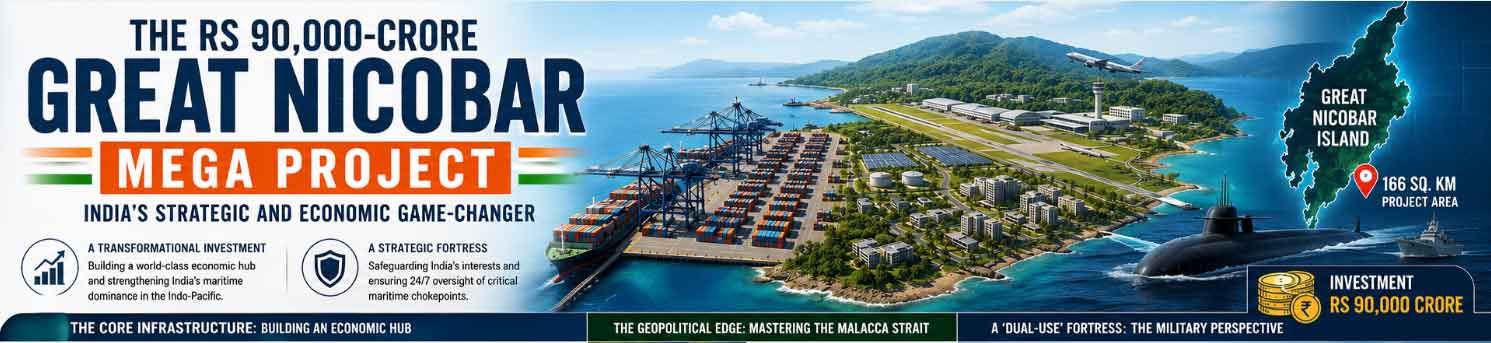
The Andaman and Nicobar Islands are on the verge of a historic transformation. The Government of India is spearheading a massive Rs 90,000-crore mega-infrastructure initiative on Great Nicobar Island (GNI). Spanning across 166 square kilometres, this ambitious project is poised to redefine India's maritime presence, boost global trade, and dramatically shift geopolitical dynamics in the Indo-Pacific region.
But what exactly makes this remote, 921-square-kilometre island at the southernmost tip of India so critical? The answer lies in a perfect blend of economic opportunity and strategic military positioning.
⚓ The Core Infrastructure: Building an Economic Hub
At the heart of the Great Nicobar Project is the vision to transform the island into a vibrant international trade and logistics hub. The master plan includes four major pillars:
- International Container Transshipment Terminal (ICTT): Located at Galathea Bay, this port aims for an eventual handling capacity of 14.2 to 16 million twenty-foot equivalent units (TEUs) annually. Phase one is expected to be commissioned by 2028 at a cost of Rs 18,000 crore.
- Greenfield International Airport: A dual-use civilian and military airfield designed to handle up to 4,000 peak-hour passengers.
- Power Generation: A massive 450 MVA gas-and-solar power plant to sustain the new infrastructure.
- Planned Township: A modern urban development to support the workforce and logistics networks.
Economically, this is a massive win for India. Currently, India heavily relies on foreign transshipment hubs like Colombo, Singapore, and Dubai to handle its cargo traffic. By building a world-class port just 40 nautical miles from the East-West shipping route, India aims to reduce logistical inefficiencies, slash supply chain costs, and integrate deeply into global shipping networks.
🗺️ The Geopolitical Edge: Mastering the Malacca Strait
In real estate and geopolitics, location is everything. Great Nicobar sits right near the Six Degree Channel, the primary trade route funneling into the Strait of Malacca.
According to the US Energy Information Administration, the Malacca Strait is the primary chokepoint for Asia and Oceania. Nearly 29% of global maritime oil flows through it. For China, this waterway is an absolute lifeline—accounting for up to 80% of its energy supplies and 70% of its total shipments.
In 2003, former Chinese President Hu Jintao coined the term "Malacca Dilemma" to describe China's vulnerability in this exact region. For India, China's dilemma is a strategic opportunity. A strong economic and military hub at Campbell Bay and Galathea Bay gives India unparalleled oversight of maritime trade and naval movements entering the Indian Ocean.
🛡️ A 'Dual-Use' Fortress: The Military Perspective
While marketed primarily as a commercial venture, defence experts and veterans consider the GNI project a brilliantly disguised "dual-use" asset.
As China expands its naval footprint in the Indian Ocean through its "String of Pearls" strategy (developing ports in Gwadar, Hambantota, and Kyaukpyu), India is responding by creating an "Eastern Wall" of defence. Rear Admiral (Retd.) Raja Menon famously described the GNI project as a potential "Indian Pearl Harbour"—a facility to establish 24/7 information dominance over the Malacca Straits.
Key Strategic Benefits Include:
- Submarine Bastion: The Bay of Bengal serves as a secure, deep-water sanctuary for India's growing fleet of Arihant-class nuclear-powered ballistic missile submarines (SSBNs).
- Tracking Adversaries: Anti-Submarine Warfare (ASW) aircraft based in the Andamans will be able to easily detect and track Chinese warships and submarines entering the Bay of Bengal through the Malacca, Sunda, or Lombok straits.
- Rapid Deployment: The dual-use airfield and upgraded docking facilities will allow Indian forces to project power swiftly across the Indo-Pacific.
🌿 Balancing Growth with Ecology
Despite its undeniable strategic importance, the scale of the Great Nicobar Project has sparked significant discussions regarding environmental sustainability. Great Nicobar is home to rich, ecologically sensitive biodiversity and indigenous tribal communities.
Experts and environmentalists have strongly advocated for transparent environmental impact assessments and strict mitigation measures. For the project to be a true success, India must walk the tightrope between securing its strategic maritime interests and preserving the delicate tribal heritage and ecological balance of the Andaman and Nicobar Islands.
Looking Ahead
If executed successfully, the Rs 90,000-crore Great Nicobar Project will be the fulcrum of India’s grand maritime strategy. It marks a historic shift from continental, land-based security thinking to a bold, ocean-facing vision. In the rapidly evolving global order of the 21st century, transforming the Andaman and Nicobar Islands from remote outposts into a thriving economic and strategic fortress is no longer just an option for India—it is a necessity.
Source Disclaimer: The facts, figures, and information presented in this article are curated from publicly available reports and data published by The Daily Telegrams, Andaman and Nicobar Islands.