The 2004 Tsunami in Andaman & Nicobar Islands: A Survivor's Memory of the Day Everything Changed
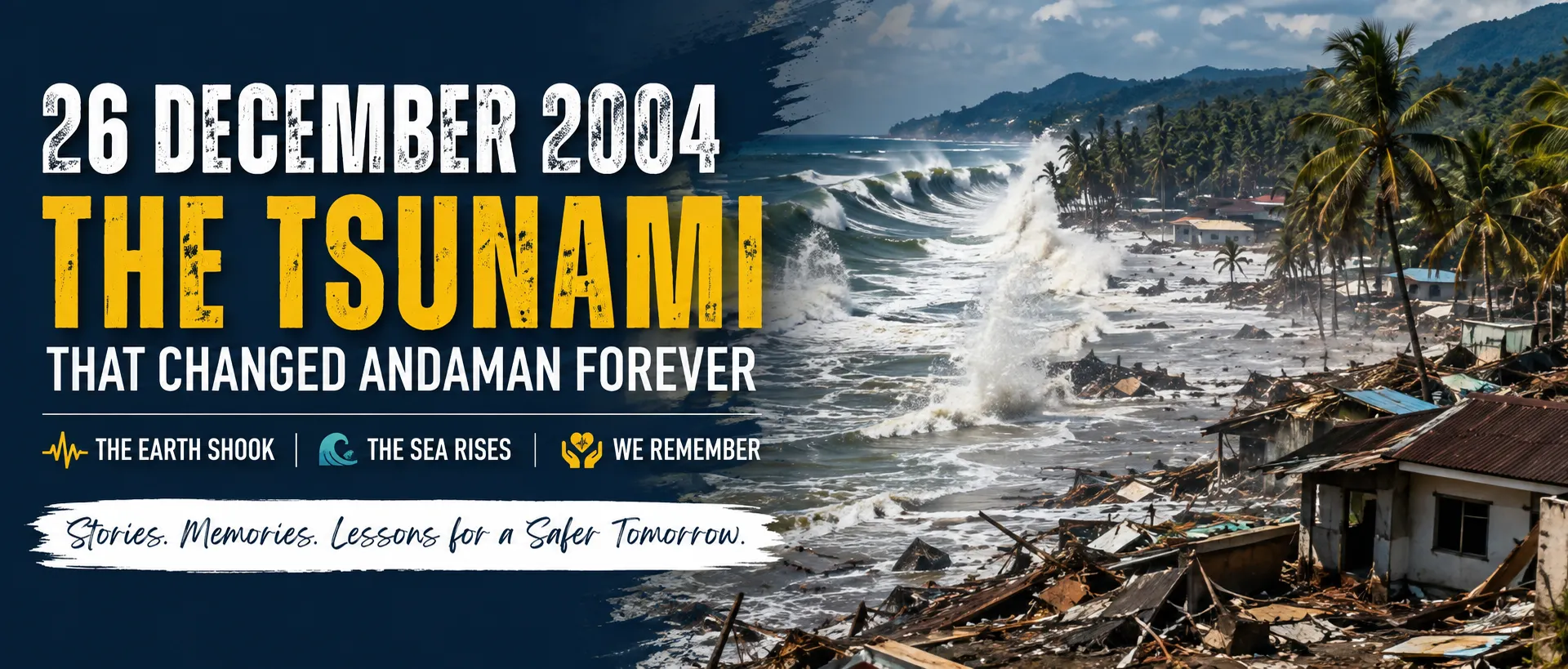
26 December 2004 is a date that remains deeply etched into the soul of the Andaman & Nicobar Islands.
For many people around the world, the 2004 Indian Ocean tsunami is a historical event described through photographs, documentaries, and statistics. But for the people who lived through it in the islands, it was something entirely different.
It was the terrifying sound of the earth shaking. It was the unusual, deceptive behavior of the sea. It was seeing fish scattered across exposed sandbars where they did not belong. It was watching people move toward the shoreline without understanding the impending danger. It was the sudden absence of food, water, and connection to the outside world.
And for many families across the archipelago, it was the day they lost their homes, their livelihoods, their relatives, and their friends.
At the time, I was a Class 10 student living in the Andaman Islands. I experienced the earthquake, the confusion that followed, and the devastating aftermath of the tsunami with my own eyes. This article is my attempt to preserve that memory while documenting the historical reality of that terrible day.
🛑 26 December 2004: The Morning the Earth Shook
The disaster began with one of the most powerful earthquakes ever recorded.
At 00:58:53 UTC, a massive earthquake occurred near Sumatra. The USGS officially identifies it as the M9.1 Sumatra–Andaman earthquake. It occurred along the subduction zone where the India Plate is forced beneath the Burma microplate. The violent vertical movement of the seabed displaced an unimaginable volume of seawater, generating a tsunami that raced across the Indian Ocean.
This was not simply an earthquake; it was the genesis of a global disaster. It affected coastal communities across the Andaman & Nicobar Islands, Indonesia, Sri Lanka, India, Thailand, and several other nations. More than 280,000 people were ultimately reported killed or missing across the region.
A Personal Memory: A Class 10 Student’s Perspective
I still remember that day because it was unlike anything I had ever experienced. The ground shook violently, and the tremor lasted for a terrifyingly long time. People were frightened because the shaking felt fundamentally different from an ordinary earthquake.
At that age, we did not understand tectonic plates or subduction zones. We knew only one thing: something was seriously wrong. But the earthquake itself was just the prelude.
🌊 When the Sea Became Strange: The Unseen Trap
One of the memories that has stayed with me most vividly is what happened at the shoreline after the earthquake.
Following the heavy shaking, the sea retreated, leaving fish flapping on the exposed sand. For many, this bizarre sight created curiosity rather than fear. People walked out toward the retreating sea, and some even tried to collect the stranded fish.
Looking back today, this memory is particularly haunting because the unusual behavior of the sea should have been an immediate warning. A tsunami does not always arrive instantly as a giant wall of water. The sea can behave strangely first. Water can pull back unusually far from the coast—only to return with enormous, inescapable force.
Then the Huge Wave Came
After the earthquake and the unusual retreat of the sea, the massive wave arrived. The situation changed in seconds. What had initially appeared as a strange natural phenomenon turned into a fight for survival. Those who had gone toward the coast were suddenly in grave danger.
🏚️ The Scale of Devastation Across the Islands
In places such as Little Andaman and the Nicobar Islands, communities suffered devastating, irreplaceable losses. The tsunami swept through coastal settlements, leveled homes, destroyed infrastructure, shattered boats, and wiped out generations of livelihoods.
The official Government of India reports later recorded 3,513 deaths and missing persons in the Andaman & Nicobar Islands, alongside widespread, large-scale destruction.
Little Andaman: A Community Devastated
Little Andaman was severely affected. Government records from January 2005 noted 50 confirmed deaths and 15 missing persons at that stage, with thousands relocated to relief camps. While statistics fluctuated as rescue operations continued, numbers can never fully describe what happened to ordinary families:
-
Homes were flattened.
-
Food supplies were washed away.
-
Fishing boats were lost to the sea.
-
Roads and communication systems collapsed.
-
Independent families suddenly had to depend entirely on relief supplies.
The Nicobar Group: The Heaviest Losses
Due to its geographical proximity to the earthquake's epicenter, the Nicobar group suffered the most catastrophic damage in India. Entire coral reefs, coastlines, agricultural lands, and coconut plantations were obliterated.
The official government casualty figures from January 2005 highlight the immense human toll during the initial relief period:
| Location | Reported Deaths | Missing Persons |
| Car Nicobar | 753 | 370 |
| Great Nicobar / Campbell Bay | 336 | 220 |
| Katchal | 303 | 4,354 |
| Kamorta | 48 | 390 |
| Chowara | 41 | 15 |
| Kondul | 38 | — |
| Little Nicobar | 43 | — |
| Pilomillow | 163 | — |
Note: These figures reflect historical government data recorded during the relief phase and represent a snapshot of the unimaginable human toll.
Car Nicobar & The Air Force Base
Car Nicobar suffered enormous destruction. The tsunami severely damaged the area around the Indian Air Force station. The Directorate of Disaster Management recorded that 111 Indian Air Force personnel and their family members were washed away when the sea breached the airbase. Families lost homes, communities lost essential infrastructure, and survivors were left desperately searching for loved ones.
🛶 Widespread Loss of Livelihoods
For island communities, the loss of a house was only one fraction of the disaster. People lost the very tools they needed to survive:
-
Fishing boats and nets
-
Agricultural land and livestock
-
Coconut plantations
-
Drinking-water sources
-
Jetties, schools, and community buildings
The Government of India’s 2005 report recorded 21,100 dwelling units damaged, alongside the destruction of 1,401 boats and 11,010 hectares of cropped agricultural area. For islanders whose lives depended intimately on the sea and the soil, these losses meant starting over from absolute zero.
🚁 Isolation, Hunger, and Rescue Operations
One of the strongest memories I have is the desperation for basic necessities. After such widespread destruction, the islands were effectively cut off. Harbors, jetties, bridges, and communication networks were destroyed.
There were days when people did not have enough food or safe drinking water. Relief became our lifeline.
I remember the sound of defense helicopters chopping through the sky, bringing relief supplies to affected communities. For ordinary people isolated by the disaster, seeing helicopters drop water bottles and biscuits was monumental. During a disaster, a simple bottle of clean water becomes the most valuable thing on earth.
The Role of the Defense Forces
The Armed forces launched one of the largest peacetime rescue missions in history. According to government reports:
-
More than 20,000 personnel from the Army, Navy, Air Force, Coast Guard, and paramilitary forces were deployed.
-
34 aircraft and 42 helicopters were pressed into service.
-
Over 6.47 lakh people were evacuated to safer locations across the wider affected regions.
-
28,734 people were actively rescued.
For remote islanders, the arrival of these forces was a beacon of hope in the darkest of times.
🗺️ How the Sea Changed the Land
The tsunami did not simply flood the islands—it physically altered their geography.
The Directorate of Disaster Management documented massive land-level changes, including coastal uplift and subsidence. Some areas of the islands were violently pushed upward, while others sank beneath the sea. The coastline changed permanently.
Historical accounts note that Trinket Island was literally divided into two, and significant portions of Indira Point (the southernmost tip of India) were permanently submerged. Long after the water receded, these geological scars remained.
🚨 Essential Lessons for Every Generation
Today, the Indian Tsunami Early Warning System (ITEWS) under INCOIS provides world-class monitoring for the Indian Ocean. But technology is only half the solution; human awareness is the other.
If there is anything we must carry forward from 26 December 2004, it is these vital safety lessons:
-
Never ignore a strong coastal earthquake: If the ground shakes violently near the coast, assume a tsunami is possible.
-
The sea provides a natural warning: An unusual retreat of ocean water or a sudden change in sea level is an immediate red flag.
-
Move to higher ground instantly: Do not wait for an official siren. If you feel a massive quake, move inland and uphill immediately.
-
Curiosity kills: Never walk toward a retreating sea to collect fish or take photos. The wave will return faster than you can run.
-
Emergency supplies are crucial: Keep basic survival items—water, medicines, flashlights—accessible.
-
Trust local knowledge: Coastal communities often sense environmental changes before technology detects them.
🕊️ A Message From a Survivor
I write this not as a disaster expert or a historian, but as someone who stood on these islands as a young student when the world turned upside down.
When I look back, I don't just remember the destruction. I remember how people helped one another. I remember the relief arriving from the skies. I remember communities digging out of the mud to rebuild their homes. I remember the islands slowly, painfully, coming back to life.
More than two decades have passed. The Andaman & Nicobar Islands have transformed. We have better infrastructure, advanced early warning systems, and stronger disaster preparedness. But the memory of 26 December 2004 remains sacred.
We remember the 143 orphaned children and 148 widows recorded in the aftermath. We honor the indigenous tribes who absorbed their orphaned children into their communities, protecting their own through traditional resilience.
For those who lost family, the grief is permanent. For those who survived, it is a solemn reminder. For the generations to come, it is a lesson.
The tsunami was our darkest chapter, but it is also our greatest story of survival. The sea took so much from us, but it could not wash away the spirit of the islands. We survived. We rebuilt. We moved forward. And we will never forget.
AndamanBlogs is an independent travel and lifestyle informational portal. The information published on this page is provided for general reference and educational purposes.
Readers should verify important information such as government rules, permits, prices, schedules, availability, contact details and other official information with the concerned authorities or service providers before making decisions.
Plan Your Andaman Trip
Looking for hotels, tours, activities or travel assistance?